AccuWeather Caught Sending User Location Data, Even When Location Sharing Is Off →

August 23, 2017 · 14:33

Zack Whittaker:

Popular weather app AccuWeather has been caught sending geolocation data to a third-party data monetization firm, even when the user has switched off location sharing.

AccuWeather is one of the most popular weather apps in Apple’s app store, with a near perfect four-star rating and millions of downloads to its name. But what the app doesn’t say is that it sends sensitive data to a firm designed to monetize user locations without users’ explicit permission.

Delete this crap and never install it again.


The VW Bus Is Back, and It’s Electric →

August 21, 2017 · 18:00

VW Newsroom:

Driven by popular demand, Volkswagen announced today it is planning on selling a production version of the award-winning I.D. Buzz concept electric vehicle in 2022 for the United States, Europe and China.

While VW still has to prove it can bring back its retro icons — they failed with the Beetle — this is the first VW I am genuinely interested in.


Cops Can Make You Unlock Your Phone With Your Fingerprint, but Not Your Passcode →

August 21, 2017 · 08:58

John Gruber:

This is why it’s so great that iOS 11’s new easily-invoked Emergency SOS mode requires you to enter your passcode after invoking it. When you’re entering customs or in a situation where you’re worried you’re about to be arrested, you can quickly disable Touch ID without even taking your phone out of your pocket.

Until iOS 11 ships, it’s worth remembering that you’ve always been able to require your iPhone’s passcode to unlock it by powering it off. A freshly powered-on iPhone always requires the passcode to unlock.

This unfortunately does not help at borders, which you should take into account while traveling to countries such as Russia, China, USA, and Australia, amongst others:

In fact, US Customs and Border Protection has long considered US borders and airports a kind of loophole in the Constitution’s Fourth Amendment protections, one that allows them wide latitude to detain travelers and search their devices. For years, they’ve used that opportunity to hold border-crossers on the slightest suspicion, and demand access to their computers and phones with little formal cause or oversight.

Even citizens are far from immune. CBP detainees from journalists to filmmakers to security researchers have all had their devices taken out of their hands by agents.


iPhone Secure Enclave Firmware Key Found →

August 21, 2017 · 08:49

David Schuetz:

Earlier today, it was reported that a hacker/researcher called “xerub” had released the encryption key, and tools to use it, for the firmware that runs the Secure Enclave Processor (SEP) on iPhone 5S. Reporting was…breathless. Stories suggested that this move was “destroying key piece of iOS mobile security,” and that we should “be on the lookout for Touch ID hacks” and “password harvesting scams.”

Is it really that bad? No, not really (…)

What was released today was the key to decrypt that firmware, but not a key to decrypt the region of disk used by the SE to store data. So now we can actually reverse-engineer the SE system, and hopefully gain a much better understanding of how it works. But we can’t decrypt the data it processes.


Sue the Manufacturer of Your Smartphone for Allowing You to Text While Driving →

August 21, 2017 · 08:41

Joe Rossignol, writing for MacRumors:

California resident Julio Ceja filed a class action complaint against Apple in January, accusing the company of placing profit before consumer safety by choosing not to implement a lock-out mechanism that would disable an iPhone’s functionality when being used behind the wheel by an engaged driver.

Ceja said his vehicle was involved in a collision with another vehicle in which the driver was texting on an iPhone.

Apple, however, told the court that it’s a driver’s fault if they choose to misuse an inherently safe iPhone while operating a vehicle. Apple essentially said it cannot be blamed simply because it manufactures the device, according to court documents filed electronically and obtained by MacRumors.

I’m going to sue the manufacturer of my TV, because I tripped over the coffee table, because I was distracted while watching Netflix. Hmm… I could try to sue Netflix too, I guess.

The absurdity of the legal system at its finest.


Google Will Pay $3 Billion to Remain Top Search Provider on iOS →

August 16, 2017 · 15:11

Luke Dormehl, writing for Cult of Mac:

Google could pay Apple as much as $3 billion this year in order to remain the default search engine on iOS devices, a new report claims.

The claim comes from Bernstein analyst A.M. Sacconaghi Jr. If true, it would represent a sizable increase from the $1 billion that Apple was paid by Google for the same reason back in 2014.

While this is (or would be) a good business decision on Apple’s part, they really should just set DuckDuckGo as the default search engine. The good of the users should come first and DDG is easily good enough for most.


Removing “Send to Watch” from Overcast →

August 12, 2017 · 14:48

Marco Arment:

I’ve spent many months of development on Overcast’s Apple Watch app, especially implementing standalone “Send to Watch” playback. Unfortunately, I now need to remove the “Send to Watch” feature.

I tried it once, soon after it debuted in Overcast. The transfer of a single podcast episode was so slow, that I never bothered again. Apple needs to fix the Watch’s biggest bottleneck.


Celebrating 30 Years of HyperCard →

August 12, 2017 · 14:44

Jason Scott:

On August 11, 1987, Bill Atkinson announced a new product from Apple for the Macintosh; a multimedia, easily programmed system called HyperCard. HyperCard brought into one sharp package the ability for a Macintosh to do interactive documents with calculation, sound, music and graphics. It was a popular package, and thousands of HyperCard “stacks” were created using the software.

In an alternative universe, my other self’s dad bought a Mac instead of an IBM PC XT. Instead of being quite adept at navigating folders in Norton Commander by the age of six or seven, I would have taught myself HyperCard.


One Other Thought on Ulysses’ Subscription Model →

August 12, 2017 · 08:59

From Ulysses’ FAQ:

What happens after my subscription or trial ends? Can I still access my texts?

Definitely. Ulysses is in read-only mode, meaning you can still access all your sheets and export them using any export format.

I strongly believe that to alleviate concerns over “renting software” instead of owning a copy, Ulysses (in this example) should still be fully functional when a user ceases paying their subscription, but it would stop receiving updates and new features. If a developer was feeling extra generous, they could support new OS versions and security updates.


So, About this Googler’s Manifesto →

August 7, 2017 · 10:07

Yonatan Zunger:

I’m writing this here, in this message, because I’m no longer at the company and can say this sort of thing openly. But I want to make it very clear: if you were in my reporting chain, all of part (3) would have been replaced with a short “this is not acceptable” and maybe that last paragraph above. You would have heard part (3) in a much smaller meeting, including you, me, your manager, your HRBP, and someone from legal. And it would have ended with you being escorted from the building by security and told that your personal items will be mailed to you. And the fact that you think this was “all in the name of open discussion,” and don’t realize any of these deeper consequences, makes this worse, not better.


Embrace the Notch! →

August 3, 2017 · 10:00

Max Rudberg:

Beforehand I was fond of the idea of blending the statusbar with the hardware, but seeing the mockups like this, I’m not so sure. Blending the statusbar with the hardware makes the screen seem smaller than it is and the result is less striking. I’m now leaning towards that Apple will embrace the notch.

I’m voting for embracing the notch, because it could play well into Apple showcasing how large the screen’s area really is. Then again, they could be conservative, so as not to alienate those who hate that look.


Photo credit: Max Rudberg


How Apple Is Putting Voices in Users’ Heads →

August 3, 2017 · 08:57

Steven Levy:

My conversation with Mathias Bahnmueller started as pretty much all my phone interviews do. “Can you hear me?” he asked, and I replied affirmatively. Then I asked him the same question. His answer was yes—he could hear me very clearly. And this was a tiny miracle.

That’s because Bahnmueller suffers from hearing loss so severe that a year ago he underwent surgery to install a cochlear implant—an electronic device in the inner ear that replaces the usual hearing mechanism. Around a million patients have undergone this increasingly mainstream form of treatment, and that’s just a fraction of those who could benefit from it. (Of the 360 million people worldwide with hearing loss, about 10 percent would qualify for the surgery.) “For those who reach a point where hearing aids no longer help, this is the only solution,” says Allison Biever, an audiologist in Englewood, CO who works with implant patients. “It’s like restoring a signal in a radio station.”

Cochlear implants bypass the usual hearing process by embedding a device in the inner ear and connecting it via electrodes to the nerve that sends audio signals to the brain. The implant gets sound from an external microphone and sound processor that usually sits behind the ear. Until now, users have had to deal with balky remote controls to adjust the settings. And dealing with smartphones has required a separate piece of equipment that vexes communication thanks to its low quality and annoying lags. But Bahnmueller, a 49-year-old executive in automotive safety, has recently been testing a new solution. The reason I was coming through so clearly is that his over-the-ear device linked to the implant was streaming directly from his iPhone—essentially putting the conversation in his head.

Technology can do so much for those less fortunate, but so rarely seems to. This is amazing.


Apple Financial Results — FY Q3 2017 →

August 2, 2017 · 08:45

Apple PR:

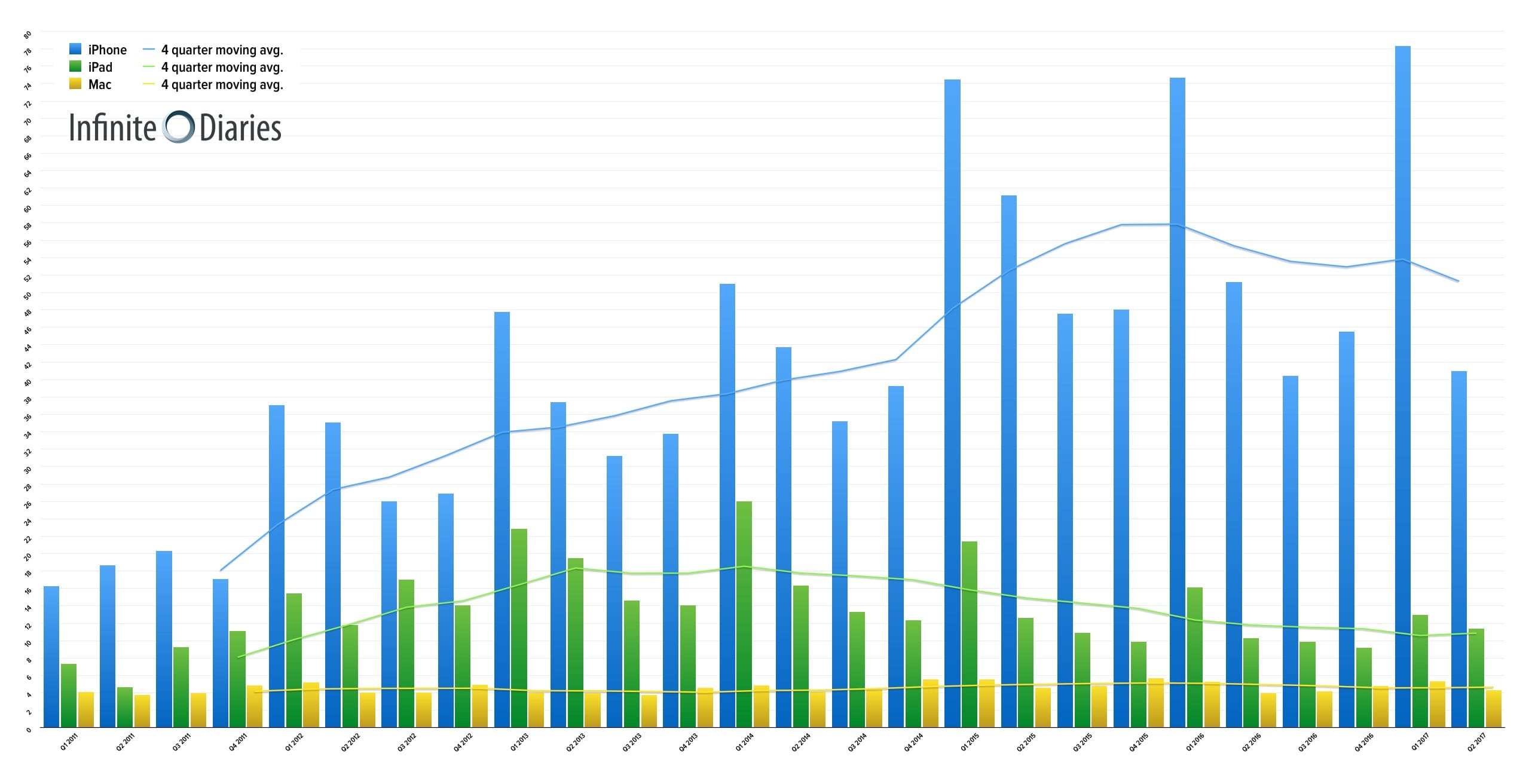
Apple today announced financial results for its fiscal 2017 third quarter ended July 1, 2017. The Company posted quarterly revenue of $45.4 billion and quarterly earnings per diluted share of $1.67. These results compare to revenue of $42.4 billion and earnings per diluted share of $1.42 in the year-ago quarter. International sales accounted for 61 percent of the quarter’s revenue.

Apple sold:

  • 41 million iPhones (40.4 million in FY Q3 2016)
  • 11.4 million iPads (10.0 million in FY Q3 2016)
  • 4.3 million Macs (4.3 million in FY Q3 2016)

Apple Should Leave the Chinese Market →

August 1, 2017 · 23:20

John Gruber:

First, let’s dispose of the notion that Apple could have chosen to defy the Chinese government and keep the VPN apps in the App Store. Technically, Apple could have done that. But if they had, there would have been consequences. My guess is that the Chinese government would move to block all access to the App Store in China, or even block access to all Apple servers, period. This would effectively render all iOS devices mostly useless. iPhones have been sagging in popularity in China for a few years now — with no access to apps, their popularity would drop to zero. And Apple would have a lot of angry iPhone-owning users in China on its hands.

When I first saw how hard Apple was pushing into China, to expand its potential market, my only thought was, that they were in it for the money. Quite frankly, I believe they should leave China. What’s more, they should never have entered it. If they choose to remain there, then they should stand by their beliefs — today it’s VPNs, tomorrow it will be asking for access to iMessages or some other nonsense. At this point all Apple can do is “pray they don’t alter the deal further.”

While this is obviously a much deeper subject, Apple being in China with the iPhone always felt wrong to me.


Defying E.U. Court, Poland Is Cutting Trees in an Ancient Forest →

August 1, 2017 · 09:18

Joanna Berendt, writing for the New York Times:

Defying an order from the European Union’s highest court, the Polish government said on Monday that it would continue logging in Bialowieza Forest, the last primeval forest in Europe and a habitat for hundreds of bison.

The decision is the latest challenge by Poland to the legal authority of the European Union, which Poland joined in 2004, and could result in financial penalties. The arch-conservative and nationalist government that took power in Poland in 2015 has been chastised by the authorities in Brussels; last week, it was formally warned that its efforts to consolidate power over the judiciary in Poland threatened the rule of law.

The Bialowieza Forest, a Unesco World Heritage site, is a relic of ancient woodlands in the middle of the European lowlands, at the border of Poland and Belarus.

Poland is so fucked right now. Soon, the EU will impose sanctions our country. Who will pay? Us of course, not the government, which has already set us back at least a decade. Another decade.


Tesla Model 3 Doesn’t Have a Key →

July 29, 2017 · 09:59

Tamara Warren, writing for The Verge:

And the best part: when I pulled into park, I asked about the key. The car doesn’t haven’t one. You control the car through the Tesla app on your phone. Tesla has succeed in making a car for gadgeteers, and for forgetful people like me that sometimes leave their phones behind. (It does have a small credit card key to hand off to valets, for people that will stunt in their 3.)

I can imagine a few scenarios where that’s a bad idea. They should add one of those rubber band Fitbit-like devices, which you can put on your wrist. I think Range Rover or Volvo does them.


CEO Says iRobot Will Never Sell Your Data →

July 29, 2017 · 09:13

David Gewirtz, for ZDnet:

First things first, iRobot will never sell your data. Our mission is to help you keep a cleaner home and, in time, to help the smart home and the devices in it work better.

iRobot further clarified:

This was a misinterpretation. Angle never said that iRobot would look to sell customer maps or data to other companies. iRobot has not had any conversations with other companies about data transactions, and iRobot will not sell customer data.

This is in response to Reuter’s report from a few days ago.


Is it “iPod shuffles” or “iPods shuffle”? →

July 27, 2017 · 22:50

Peter Rojas, writing for Engadget on 19 January 2005:

It took us a few days of harrassing Apple’s PR department, but we were finally able to answer one of the most burning questions of the past seven days: Is it “iPod shuffles” or “iPods shuffle?” Here’s a transcript of our conversation…

If Phil Schiller answered, he’d probably troll Peter with “iPod Shuffle devices.”


Roomba Wants to Sell Maps of Homes Its Robots Clean →

July 25, 2017 · 10:38

Jan Wolfe, reporting for Reuters:

Angle told Reuters that iRobot, which made Roomba compatible with Amazon’s Alexa voice assistant in March, could reach a deal to sell its maps to one or more of the Big Three in the next couple of years.

I was recently considering buying a Roomba or one of the copycats on the market but I have now changed my mind. I will gladly pay more for a product that does not make me the… product.


Poland — Basically A Dictatorship →

July 20, 2017 · 16:04

Rick Lyman, writing for the New York Times:

An enraged Jaroslaw Kaczynski — the former president’s twin brother and, as leader of Law and Justice, the most powerful political figure in Poland — seized the lectern and fired back: “Do not wipe your traitorous mugs with the name of my late brother. You are scoundrels.”

Law and Justice has long maintained that the 2010 crash was an assassination, perhaps involving Russia and members of the political opposition.

“You murdered him,” Mr. Kaczynski shouted.

Ewa Kopacz, the prime minister under the previous center-right government, declared herself flabbergasted. “This man is crazy with hate,” she said of Mr. Kaczynski. “He cannot control his emotions.”

When Trump won, I thought USA was worse off than Poland.

I was wrong.


Censoring Porn in the UK →

July 18, 2017 · 08:52

Kelly Fiveash, writing for Ars Technica:

Under the yet-to-be-implemented measures, free and fee-based porn operators—many of which are based abroad—will be required to insert age checkers on their sites in the UK, forcing users to dish up their credit card details to prove that they are 18 or over before being granted access to smut.

Hackers are dry-washing their hands right now.


Dell Is Selling the World’s First Wirelessly Charging Laptop →

July 12, 2017 · 09:09

Shannon Liao:

Well, it’s not the tablet part that has wireless charging capabilities, as Dell achieves that through a kind of hack. The company uses an attachable keyboard, sold separately, as a wireless charging base, although the keyboard cannot be charged beforehand and you can’t use it on any metal surfaces.

Dell said today that the Latitude 7285 12-inch is available for sale on its website starting at $1,199.99, and the Wireless Charging Keyboard and Wireless Charging Mat will run you $549.99. (You save $29.99 if you buy them together versus separately.)

This is not wireless charging — it’s inductive charging at best, with the wire moved from the laptop to the charging mat.


Winamp’s Woes: How the Greatest MP3 Player Undid Itself →

July 7, 2017 · 18:26

Cyrus Farivar, writing for Ars Technica:

Today, Winamp continues to be updated; AOL released its first Android version in 2010 and a Mac version in 2011. Amazingly, given all the time elapsed, AOL still makes a decent amount of money on the site and on the program—while the company has declined to release official figures, former employees who worked on Winamp estimate its current revenue at around $6 million annually. And Winamp still has an estimated user base of millions worldwide, a small fraction of which live in the United States.

When I first got my hands on Winamp, I learned that ID3 tags existed. That was when I started properly naming all my MP3 files, in both the file names and tags. I got my first iPod in 2006 and switched to iTunes, which I still use today. What’s more, I still have those 128 Kbps MP3 files — some I replaced with better rips, others I just left as they were. My iTunes library was automatically perfectly organized, thanks to Winamp. This was a time when the iTunes Music Store wasn’t yet available in Poland, so I solely relied on ripping my CDs. I did get an US account later and a few gift cards, which made things easier, but this was after Apple dropped DRM, if I recall correctly. I still have fond memories of Winamp, despite the fact that I’m probably one of the few people who like using iTunes, and was quite surprised recently, when I learned that one of my friends still uses it. I didn’t know there was a Mac version either…


RED is Making a $1,200 Smartphone With a ‘Holographic Display’ →

July 7, 2017 · 08:25

Sean O’Kane:

High-end cameramaker RED has just announced a premium smartphone called Hydrogen One, and the headlining feature is something the company is referring to as a “holographic display.” A buzzword-filled press release for Hydrogen One says that the 5.7-inch display somehow uses nanotechnology to “seamlessly [switch] between traditional 2D content, holographic multi-view content, 3D content, and interactive games.”

The teaser image paints it as hideously ugly. That design might work on RED’s cameras, but it sure doesn’t look good on a smartphone. Waiting to see the finished product, but there’s no way I’d put down $1200-1500 on that without seeing the whole picture.