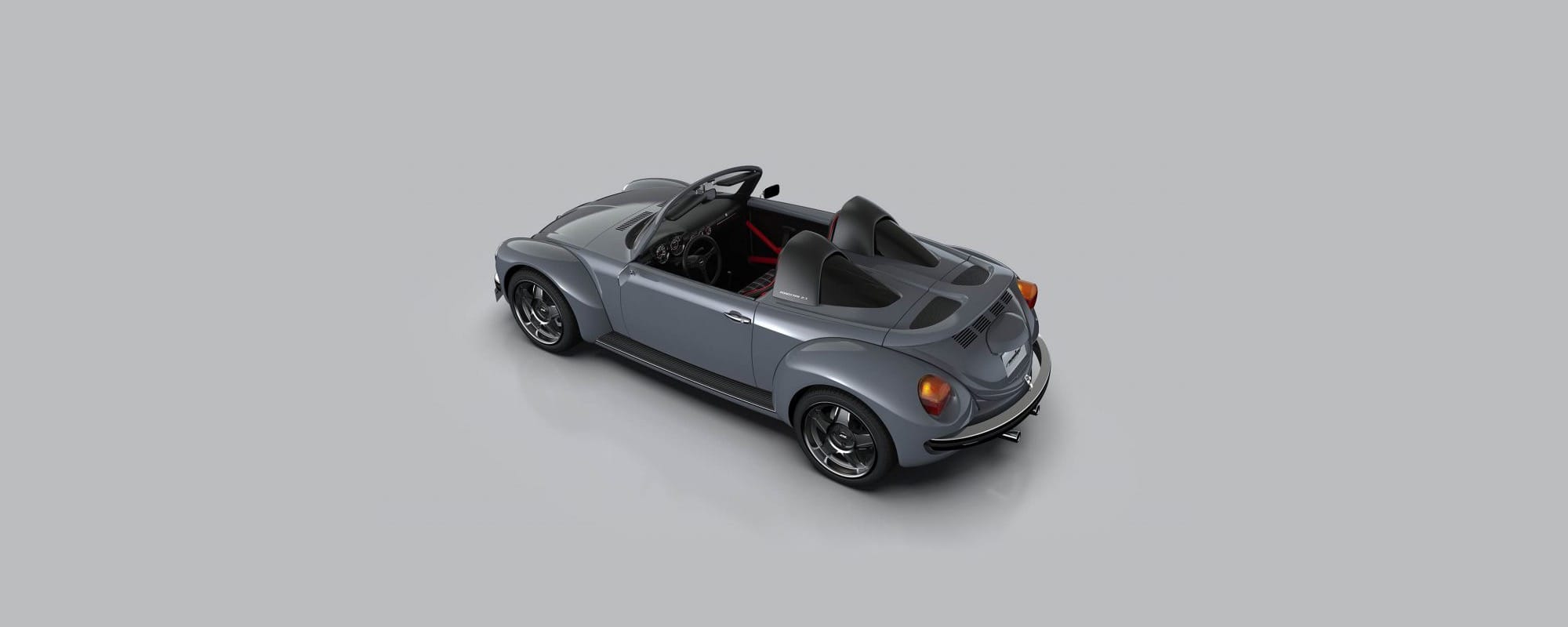
Jony Ive — How Bad Can He Be? →

May 10, 2018 · 01:15

Benjamin Clymer, for Hodinkee Magazine:

Sir Jonathan Ive, Chief Design Officer of Apple, Inc., is sitting across from me at a seamless white oak table. We’ve met a few times before, and I know he cares about watches. He must, right? But I’ve never actually asked him. So I do. And thank God, he does – he recounts a tale of buying an Omega Speedmaster Professional in the early ’90s. I exhale, because the hypothesis of this interview, at least in my mind (likely not in Apple’s), is that the watch industry and its all-too-vocal supporters have got it all wrong. Jony, the creator of what is, by at least one definition, the number one watch on Earth, is a friend, not a foe. But, like any great question of power and influence, it’s not so simple.

This is one interview worth reading, especially for those of you into horology or Apple Watch. Or both! And that ending — it’s perfect.

iMac Pro & Hasselblad H6D Photo Review: Antarctica →

May 9, 2018 · 13:48

Austin Mann, on his blog:

Twenty years ago today (May 6, 1998), my dad walked into my classroom on the last day of school holding an inkjet print. He handed it me and said, “You’re going to want one of these!” On this piece of paper was the just-announced Bondi Blue iMac […]

Today, after a few months with the iMac Pro, I can say in many ways it stays true to its original ancestor. It packs a powerful punch and continues to deliver on its promise to be a simple yet powerful tool that unlocks creative potential in people.

Screw the iMac Pro review (just kidding, don’t) and look at his shots from Antarctica!


Pocket Casts Addressing Our Concerns →

May 8, 2018 · 10:44

From Shifty Jelly’s blog:

That’s an easy question to answer for those that know a bit about the podcasting industry. The industry is amazing because it’s open. Anyone can publish a podcast and distribute it everywhere. No podcast is treated differently than another. However, “open” is not the default state of markets as they mature, as we’ve seen in other content businesses. When power is consolidated into the hands of just a few closed platforms, creators rarely win. And we care deeply about the fate of podcast producers everywhere.

It’s our mission to ensure that this doesn’t happen. If we succeed, we all benefit. If we lose, well, we feel it was a thing worth attempting. In the meantime there are some steps we need to take to get where we want to go, and we’ll talk about those when we’re ready. It’s early days, but we’re really excited for the future. Hope you all are too!

That’s what the guys at Shifty Jelly were doing before they were bought — building an open community around an open medium. I hope I’m wrong, but historically when a private company buys a product, it isn’t to further an “open” agenda, but to benefit their own product(s) at the cost of those who care that podcasts remain the way they are. Perhaps it’s the cynic in me, but while I believe everything they are saying now (I’m sure they believe it too), I’m willing to bet this will slowly change over time, as it has so frequently in the past.


Why a Massive Sinkhole Tore Open in New Zealand →

May 8, 2018 · 10:27

Sarah Gibbens, for National Geographic:

New Zealand’s newest sinkhole may be one of its largest. It extends down more than six stories. From end-to-end, it measures just about the length of two football fields. The sinkhole is so large it even exposed 60,000-year-old volcanic soil.


One Space Between Each Sentence, They Said →

May 6, 2018 · 09:58

Avi Selk, writing for The Washington Post:

Ob viously, thereneed to be standards. Unless    you’re doing avant – garde po e try, or    something , you  can’tjustspacew ords ho w e v   e    r   y      o        u            want.     That would be insanity. Or at least,

obnoxious.

Enter three psychology researchers from Skidmore College, who decided it’s time for modern science to sort this out once and for all.

I’m still not convinced, especially since the test was conducted using a fixed-width font. The article is perfect though — go read it, spacing and all. It also has the perfect correction:

Note: An earlier version of this story published incorrectly because, seriously, putting two spaces in the headline broke the web code.

via @ania13


Apple Took 8 Days to Give Jefferson the Data It Had Collected on Him →

May 5, 2018 · 11:53

Jefferson Graham:

The zip file I eventually received from Apple was tiny, only 9 megabytes, compared to 243 MB from Google and 881 MB from Facebook. And there’s not much there, because Apple says the information is primarily kept on your device, not its servers. The one sentence highlight: a list of my downloads, purchases and repairs, but not my search histories through the Siri personal assistant or the Safari browser.

This approach by Apple makes me trust them more with my data than any other company.


Pocket Casts Acquired by NPR, etc. →

May 4, 2018 · 00:17

Chris Welch, on The Verge:

Pocket Casts, widely considered to be one of the best mobile apps for podcast listening, has been acquired by a collective group that includes NPR, WNYC Studios, WBEZ Chicago, and This American Life. “This unprecedented collaboration furthers public radio’s leading role as an innovator in audio discovery and distribution, while ensuring the continued support and growth of one of the most popular listening platforms on the market,” the companies said in a press release announcing the news. That team of stations and podcast producers are responsible for some of the format’s biggest hits like This American Life (duh), Serial, Radiolab, and Planet Money.

Moving forward, Pocket Casts will operate as a joint venture between the new owners. Philip Simpson and Russell Ivanovic, who formed Shifty Jelly (Pocket Cast’s developer) in 2008, will have unspecified “leadership roles.” The existing staff and development team is staying put. Owen Grover, a veteran of iHeartRadio / Clear Channel, has been named as Pocket Cast’s CEO. NPR’s apps including NPR One will remain in development.

Rest In Peace Pocket Casts, good luck Russell and Philip.

Everyone on iOS go get Overcast [App Store]. I have no clue what you should do if you’re on Android.


The 2017 Panic Report →

May 4, 2018 · 00:04

Cabel Sasser, on Panic’s blog:

Hello, my friends. It’s (Q2) of a (not-so) new year. That means it’s time to talk about Panic!

I look forward to these every year and having recently switched to Transmit Mac, I was saddened to see Transmit iOS retired. Transmit has become my go-to software to not only interface with various servers, but to access my Dropbox, GDrive, etc. I don’t have to rely on their respective apps anymore, which is worth getting Transmit in itself.


Unsecured IP Video Cameras Directory →

May 3, 2018 · 23:20

Welcome to Insecam project. The world biggest directory of online surveillance security cameras. Select a country to watch live street, traffic, parking, office, road, beach, earth online webcams. Now you can search live web cams around the world. You can find here Axis, Panasonic, Linksys, Sony, TPLink, Foscam and a lot of other network video cams available online without a password. Mozilla Firefox browser is recommended to watch network cameras.

These cameras have no passwords set. Some on purpose, others not so much.


I Wouldn’t Expect a Cheaper iPhone X After What Tim Cook Said Last Night

May 2, 2018 · 12:47

Tim Cook on Apple’s earning’s call:

We were surprised, somewhat, that through all of this period of time that the iPhone X winds up at the most popular for every week of the time since the launch and so that’s, I think, a powerful point. And it’s number one in China, which is another powerful point. And so obviously at some point if those technologies move to lower price points and that [inaudible] probably more unit demand. But the way we think about is trying to price a reasonable price for the value that we deliver and I feel that we did that.

There were plenty of recent rumours suggesting the iPhone X’s price would go down by $100 to $899, perhaps also to make way for an iPhone X Plus at the $999 price point. After hearing Tim’s remarks on the X last night, I wouldn’t expect the price to go down anytime soon — the iPhone X is selling extremely well, and people are voting with their wallets by buying them. You just don’t walk away from that as Apple.

I hope I’m wrong.

(You can find a full transcript of the call on iMore.)


Apple Financial Results — FY Q2 2018 →

May 2, 2018 · 12:39

Apple PR:

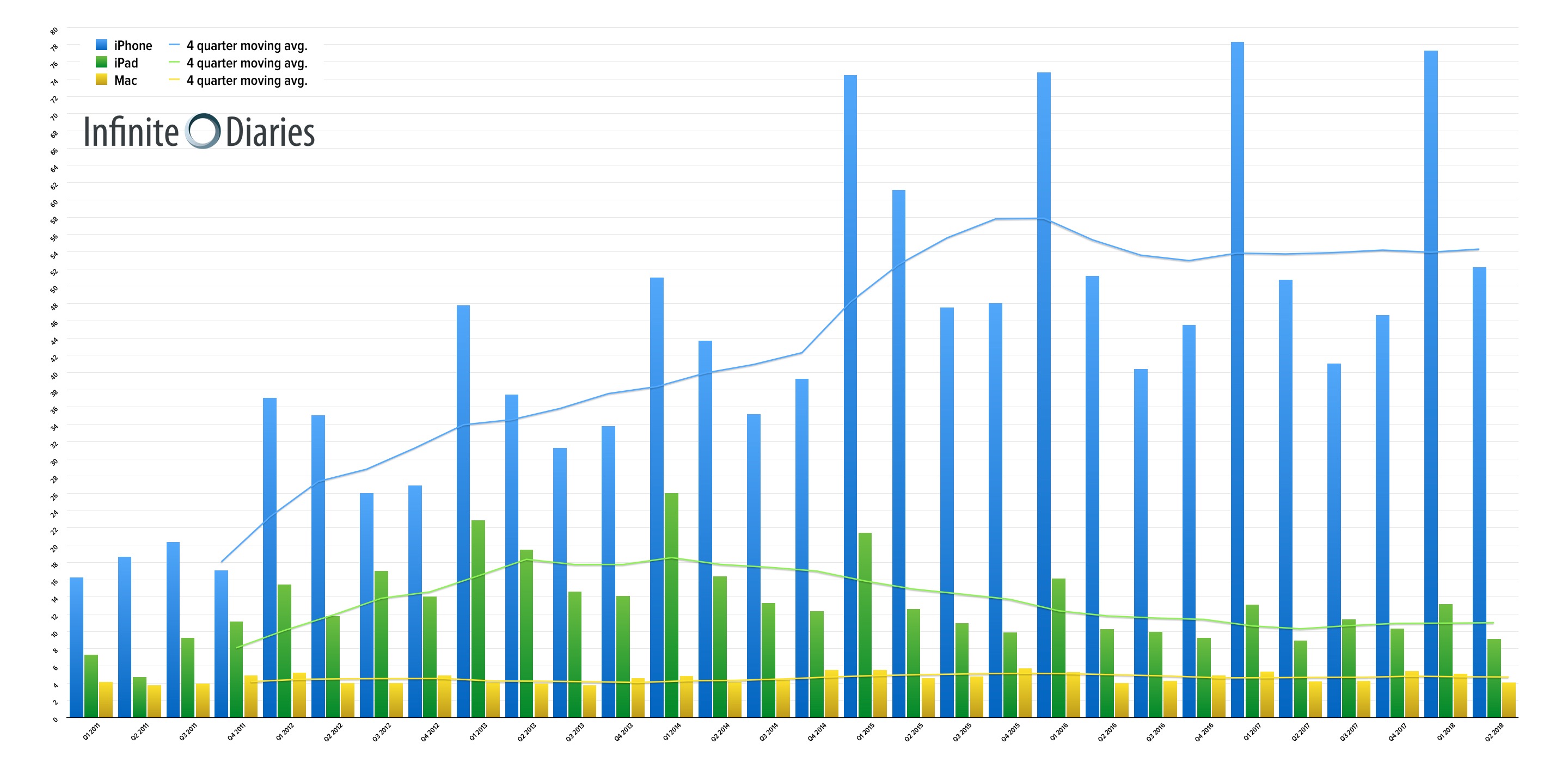
Apple today announced financial results for its fiscal 2018 second quarter ended March 31, 2018. The Company posted quarterly revenue of $61.1 billion, an increase of 16 percent from the year-ago quarter, and quarterly earnings per diluted share of $2.73, up 30 percent. International sales accounted for 65 percent of the quarter’s revenue.

Apple sold:

  • 52.217 million iPhones (50.763 million in FY Q2 2017)
  • 9.113 million iPads (8.922 million in FY Q2 2017)
  • 4.078 million Macs (4.199 million in FY Q2 2017)

John Gruber Has Further Details On Project “Marzipan” →

May 1, 2018 · 09:25

John Gruber, for Daring Fireball:

This “Marzipan” rumor got a lot of people excited. But Gurman’s report is so light on technical details that the excitement is based mostly on what developers hope it could mean, not what’s actually been reported. The less specific the rumor, the easier it is to project your own wishes upon it. And, oddly perhaps, we haven’t seen any additional rumors or details about this project in the four months since Gurman’s original report.

I’ve heard a few things, from first- and second-hand sources. Mostly second-hand, to be honest, but they’re all consistent with each other.

Firstly, the details John posted shed more light on iOS and macOS in the coming years.

Secondly, since this is in regard to Gurman’s “Marzipan” leak, Mark isn’t as credible as he once was:

Gurman doesn’t mention that the meeting was leaked to Gurman himself — the person who leaked this story was caught and fired.


WhatsApp and Facebook — A Massive Culture Clash Over Encryption →

May 1, 2018 · 09:08

Elizabeth Dwoskin, writing for The Washington Post:

The WhatsApp co-founders were also big believers in privacy. They took pains to collect as little data as possible from their users, requiring only phone numbers and putting them at odds with data-hungry Facebook. At the time of the acquisition, Koum and Acton said Facebook had assured them that WhatsApp could remain an independent service and would not share its data with Facebook […]

Another point of disagreement was over WhatsApp’s encryption. In 2016, WhatsApp added end-to-end encryption, a security feature that scrambles people’s messages so that outsiders, including WhatsApp’s owners, can’t read them. Facebook executives wanted to make it easier for businesses to use its tools, and WhatsApp executives believed that doing so would require some weakening of its encryption.

Facebook’s Mark Zuckerberg and Sheryl Sandberg don’t know when to stop.


2016 MacBook Pro Butterfly Keyboards Failing Twice as Frequently as Older Models →

April 30, 2018 · 23:20

Mike Wuerthele, writing for AppleInsider:

Following anecdotal reports of a keyboard more prone to failure than in previous years, AppleInsider has collected service data for the first year of release of the 2014, 2015, and 2016 MacBook Pros, with an additional slightly shorter data set for the 2017 model year given that it hasn’t been available for a year yet.

Not including any Touch Bar failures, the 2016 MacBook Pro keyboard is failing twice as often in the first year of use as the 2014 or 2015 MacBook Pro models, and the 2017 is better, but not by a lot.

I have had an issue with my 2016 13” MacBook Pro, which is described by Apple as a “popping sound”. I contacted Apple Support and sent them a video, and they immediately set up an appointment with my closest AASP to fix the issue. They fixed it in 24 hours by replacing the whole top case, which includes the keyboard, battery, and speakers. The “popping sound” happens when the keyboard gets too warm and some keys start making a different sound. They also feel marginally stickier when pressed.

The new keyboard feels and sounds different — it’s quieter and a bit stiffer. I’m not sure if this is the same one as in the 2017 model, but I hope it stays fixed. Since this is a problem with the design and the fix is very expensive, I expect Apple to support their users indefinitely (or at least 5-6 years) — we already paid a lot for the MacBook Pro and we should not pay more for design mistakes.

Despite this being a frustrating issue, Apple Support and my AASP were stellar in helping me out.


Rama Works M60-A Keyboard →

April 30, 2018 · 10:25

The M60-A represents the benchmark and equilibrium between function and design for us at Rama Works. The gently exaggerated design of the frame is not understated, but rather provocative. Inspiration and evolution from previous models are evident in the beautifully articulated design and the well defined aesthetic, the fingerprint of our ‘Industrial Modern’ designs. The M60-A offers a unique contender in the traditional 60% form factor.

The attention to detail in this design is quite amazing. If not for its considerable height and lack of arrow keys, I would be ordering it right now.


Marco Arment’s Stellar Privacy Update →

April 28, 2018 · 08:46

Marco Arment, on his blog:

One of the ways publishers try to get around the limitations of the current model is by embedding remote images or invisible “tracking pixels” in each episode’s HTML show notes. When displayed in most apps, the images are automatically loaded from an analytics server, which can then record and track more information about you.

In Overcast 4.2, much like Mail (and for the same reason), remote images don’t load by default. A tappable placeholder shows you where each image will load from, and you can decide whether to load it or not.

This is one developer I would trust with my data without hesitation. I’m keeping my email-based login for Overcast, even though he’ll probably hate me for burdening him with it.


3D Touch Is the Single Best Way to Manipulate the Cursor and Text on the iPhone →

April 28, 2018 · 08:27

John Gruber, on Daring Fireball:

3D Touch is the sort of feature that either needs to be on all iPhones or else should be dropped. If it’s not pervasive across the entire platform, developers can’t count on it. I think that’s why it’s underutilized today. But it’s one thing to wait for older iPhones from the pre-3D Touch era to drop out of usage. It’s another for Apple to sell a brand new phone in 2018 without it.

I would happily replace my iPhone X with this new rumoured cheaper 6.1” device, but it will supposedly lack two things: the aforementioned 3D Touch layer and a dual camera system.

Apple will be able to use the camera as a differentiator in the close future, but as more and more Android phones adopt this technology, it will become a standard and expected feature quickly. But I cannot imagine them shipping a new iPhone without 3D Touch. We’ve been using it for three generations now, so it’s high time for it to be more pervasive across all devices, including iPads. Even if developers don’t actively support it, this is the single best way to manipulate the cursor and text on the iPhone. The iPad gets away with two fingers for now, but it really could use this tech.


Witold Pilecki — the Man Who Volunteered for Auschwitz →

April 27, 2018 · 13:34

Marina Amaral, on her blog:

Witold Pilecki was a reserve officer in the Polish Army born 13 May 1901 in Olonets, Russia. During World War II while attached to a Polish resistance group, he volunteered for an operation that saw him intentionally imprisoned in Nazi Germany’s Auschwitz death camp in order to gather intelligence on the site’s operations. As early as 1941, Pilecki’s reports informed the Western Allies of the atrocities being committed at the death camp. Before escaping Auschwitz, Pilecki organized a resistance movement right under the noses of the camp’s Nazi German overseers, kapos and administrative staff.


Apple Officially Discontinues AirPort Routers →

April 27, 2018 · 13:28

Zac Hall received Apple’s official statement on the topic of their AirPort routers:

We’re discontinuing the Apple AirPort base station products. They will be available through Apple.com, Apple’s retail stores and Apple Authorized Resellers while supplies last.

I’m surprised they chose to exit this market, especially since integrating mesh Wi-Fi into their existing products could be such a huge feature. I’d love for my HomePods and Apple TVs to extend the internet automatically in and around my house. This would additionaly be a great incite to actually buy more HomePods and would allow people to have less clutter in their houses.


Choosing a Wi-Fi Router to Use With Apple Devices →

April 27, 2018 · 13:22

Apple Support:

For the most compatibility, reliability, and performance when used with Apple devices, look for a Wi-Fi router that offers these features…

If you just have a regular-sized apartment, just get a good 802.11ac router from a reputable manufacturer, but if you need great coverage over a larger area, mesh Wi-Fi, such as Eero or their competitors, is the way to go. Personally, I wouldn’t ever get Google’s WiFi mesh solution — I simply wouldn’t trust them with so much of my data.

If you are however looking for a Time Capsule replacement, just additionally get a 2 or 4-bay QNAP NAS and configure the Time Machine backup feature on it. I have been using mine for years now and it has been flawless, better than Apple’s own product, which required me to reset my backups every few months, due to some sort of error.


Google Has More of Your Personal Data Than Facebook →

April 23, 2018 · 11:04

Christopher Mims, for The Washington Post:

As justifiable as the focus on Facebook has been, though, it isn’t the full picture. If the concern is that companies might be collecting some personal data without our knowledge or explicit consent, Alphabet’s Google is a far bigger threat by many measures: the volume of information it gathers, the reach of its tracking and the time people spend on its sites and apps […]

It’s likely that Google has shadow profiles on at least as many people as Facebook does, says Chandler Givens, chief executive of TrackOff, which develops software to fight identity theft. Google allows everyone, whether they have a Google account or not, to opt out of its ad targeting. Yet, like Facebook, it continues to gather your data […]

Google also is the biggest enabler of data harvesting, through the world’s two billion active Android mobile devices. Because Google’s Android OS helps companies gather data on us, then Google is also partly to blame when troves of that data are later used improperly, says Woodrow Hartzog, a professor of law and computer science at Northeastern University.

A good example of this is the way Facebook has continuously harvested Android users’ call and text history. Facebook never got this level of access from Apple ’s iPhone, whose operating system is designed to permit less under-the-hood data collection. Android OS often allows apps to request rich data from users without accompanying warnings about how the data might be used.

Meanwhile, we still don’t have the tools or means to protect ourselves from being targeted by Google, Facebook, and others, or to block their tracking practices completely.


Smothered by Smog — Polish Cities Rank Among Europe’s Dirtiest →

April 23, 2018 · 10:23

Maciek Nabrdalik and Marc Santora, for The New York Times:

High atop the ski lift at Zar Mountain in southern Poland, the villages below disappear. At first, they seem obscured by morning fog. But the yellow haze does not lift. It hangs heavy, the contrast with the white snow making it clear that something is off.

What is off is the air. Poland has some the most polluted air in all of the European Union, and 33 of its 50 dirtiest cities. Not even mountain retreats are immune.

The problem is largely a result of the country’s love affair with coal. Like elsewhere in Poland, most of the homes in the villages below Zar Mountain are still heated by coal. Some 19 million people rely on coal for heat in winter. In all of the European Union, 80 percent of private homes using coal are in Poland.

Our past and current governments’ policies are unacceptable. I’m afraid not much will change for the better until we finally have fresh, forward-thinking, and honest candidates that manage to win elections. I’m not holding my breath, although I guess I should be.


Why You’ve Never Heard of the Six Chinese Men Who Survived the Titanic →

April 21, 2018 · 10:55

Amy B Wang, writing for The Washington Post:

Hundreds of passengers fled in lifeboats. Hundreds more perished, going down with the ship or freezing to death in the icy water. The only one of Titanic’s lifeboats to turn back to the wreckage found body after body — until it discovered a young Chinese man, still alive, clinging to a piece of wood.

That man would be one of six Chinese passengers who survived the Titanic, a little-known fact about the historic disaster that has largely remained untold or distorted, owing to a racially hostile environment toward Chinese people in the West at the turn of the 20th century.

Fascinating read.


Wavelength for Micro.blog →

April 20, 2018 · 12:03

Manton Reece:

We’re rolling out a new hosted plan on Micro.blog to accommodate microcasts. When you upload an audio file to your site — either from the web, Wavelength, or a third-party app — Micro.blog will automatically create a podcast feed for your microblog. Listeners can subscribe directly, or you can add the feed to the Apple Podcast Directory and it will show up in popular apps like Overcast and Castro. Everything can be served from your own domain name, just like a normal microblog. We’ve been using this infrastructure for all the episodes of our weekly Micro Monday microcast.

New hosted microblogs with microcasting support will be $10/month. Microcast audio files will be limited to 20 MB. Existing microblogs hosted on Micro.blog can be upgraded to support microcasting for an additional $5/month.

It’s fascinating watching how fast Manton is innovating and expanding Micro.blog. I have immense respect for him and his project, especially since it focuses on utilizing open technologies. I hope his next logical step will be to offer support for longer podcasts.


Are External GPUs for Macs Viable in macOS 10.13.4? →

April 20, 2018 · 11:05

Samuel Axon, writing for Ars Technica:

We tested an eGPU enclosure with a Thunderbolt 3-equipped MacBook Pro, and found that, in most applications, performance didn’t disappoint. Unfortunately, we also found limitations and software support inconsistencies that prevent the Mac eGPU dream from being fully realized at this time.

This is an extremely tempting solution. I imagine my current setup changing from a Hackintosh and MacBook Pro 13” to just a MacBook Pro 13” with a eGPU setup and external monitor. There would be a few caveats: I’d need a 2 TB SSD in the MacBook, at least a 4K monitor, preferably supporting Display P3 (my current 4K Eizo is sRGB), and I’d want one of those new quad-core Core i7s from Intel. They’re already available but Apple hasn’t yet ingested them into the lineup.

That and a reliable keyboard — my MacBook Pro is currently in for service for a new one.


Jason Snell on His iPad Setup →

April 20, 2018 · 10:59

Jason Snell, on Six Colours:

A reader on Twitter suggested I buy this iPad stand on Amazon, and I’ve been using it ever since. It’s surprisingly sturdy. The base that approximates the foot of an iMac is metal, not plastic. A hinge lets me pivot the iPad up and down and likewise doesn’t feel cheap. And the clip mechanism—the stand comes with clips for large and small iPads—is strong enough to hold my iPad without any worry of it sliding out. Best of all, the thing rotates, so I can use my iPad in portrait (for more words on the screen) or landscape (for use with Split View) as I see fit […]

I found what I think is the exact same model of stand that Jason is using, but available on Amazon.de in Europe — it’s under a different name though. I will be ordering this stand later today and hope it’s not a cheap knock-off.

[…] I replaced the Mini Tactile Pro with the Matias Laptop Pro, a Bluetooth mechanical keyboard with a silver-and-black style that fits in pretty well with my iPad and its stand. Until I find something better—let’s face it, I appear to be collecting mechanical keyboards—this is my preferred writing environment when I’m away from my desk. At least until my kids come home from school, at which point I have to go back into my office and close the door.

I’ve been tempted to buy a mechanical keyboard for my Hackintosh for a number of years now, but the WASD V2 that I want, with custom keys, is a bit too expensive to ship to Europe from USA. It doesn’t have Bluetooth either, so I couldn’t use it with my iPad Pro. Jason has tempted me to get the Matias, but it’s over 150 GBP to have it shipped to Poland from the UK — I’ll leave it on my wish list for now and continue using my Apple Wireless Keyboard in the meantime.


Tim Cook: “Users Don’t Want iOS to Merge With macOS” →

April 20, 2018 · 10:48

Peter Wells, speaking with Tim Cook:

“I generally use a Mac at work, and I use an iPad at home,” Cook tells me, “And I always use the iPad when I’m travelling. But I use everything and I love everything.”

Later, when I ask about the divide between the Mac and iOS, which seems almost conservative when compared to Microsoft’s convertible Windows 10 strategy, Cook gives an interesting response.

“We don’t believe in sort of watering down one for the other. Both [The Mac and iPad] are incredible. One of the reasons that both of them are incredible is because we pushed them to do what they do well. And if you begin to merge the two … you begin to make trade offs and compromises.

This is nothing new — Tim Cook already made this statement a few years go.

I spent many days working solely with a Microsoft Surface Pro 4 the quickest summary I can come up with would be: it’s a good enough notebook, but a terrible tablet, at least in comparison to the iPad. The one situation I really liked it in, was editing photos in Lightroom, where I could detach the keyboard and focus on using touch. The iPad on the other hand, which I use every single day since it came out in 2010, is a great tablet and not a very good notebook. I guess it all depends where you’re coming from — Windows 10, as a desktop operating system, hasn’t yet evolved to be a great mobile OS1, while iOS is the exact opposite, even though iOS 11 helped a lot in that regard.

We’re currently at these strange crossroads between the past and future, while everyone is trying to figure out how to go forward, but it appears they don’t yet know which turn to take.

  1. It’s not a stellar desktop OS at the moment either — they still haven’t figured out HiDPI.